
Brick Inlay delivers a high quality, modern design with a traditional brick aesthetic at 33 Cremorne

33 Cremorne is an architectural masterpiece. Designed by Hassell for Vicland, it’s a clear and thoughtful expression of materiality, craft and context, and a high-quality commercial workspace with outstanding amenity true to Hassell’s motto of creating places people love.
Ingrid Bakker, Hassell Principal, aptly describes Cremorne’s attraction: “It’s a bit gritty and a bit industrial and quite similar to areas of New York being reimagined from an industrial past.”
Cremorne is familiar territory for Hassell, Ingrid recently leading the design of SEEK’s HQ building across the road. “We were really conscious of making sure 33 Cremorne was different to SEEK, but it was important for the two buildings to have a conversation with one another.” Drawing on their knowledge of the area and further research into its industrial character, the team studied surrounding warehouses and contextual buildings to shape the material response.
Brick was central to the palette from the outset.

“We liked the idea of using real brick and recycled bricks for the whole facade, so we explored how that would come together. We were able to build the planter boxes on the ground floor from real brick, so we wanted to match it,” says Ingrid.
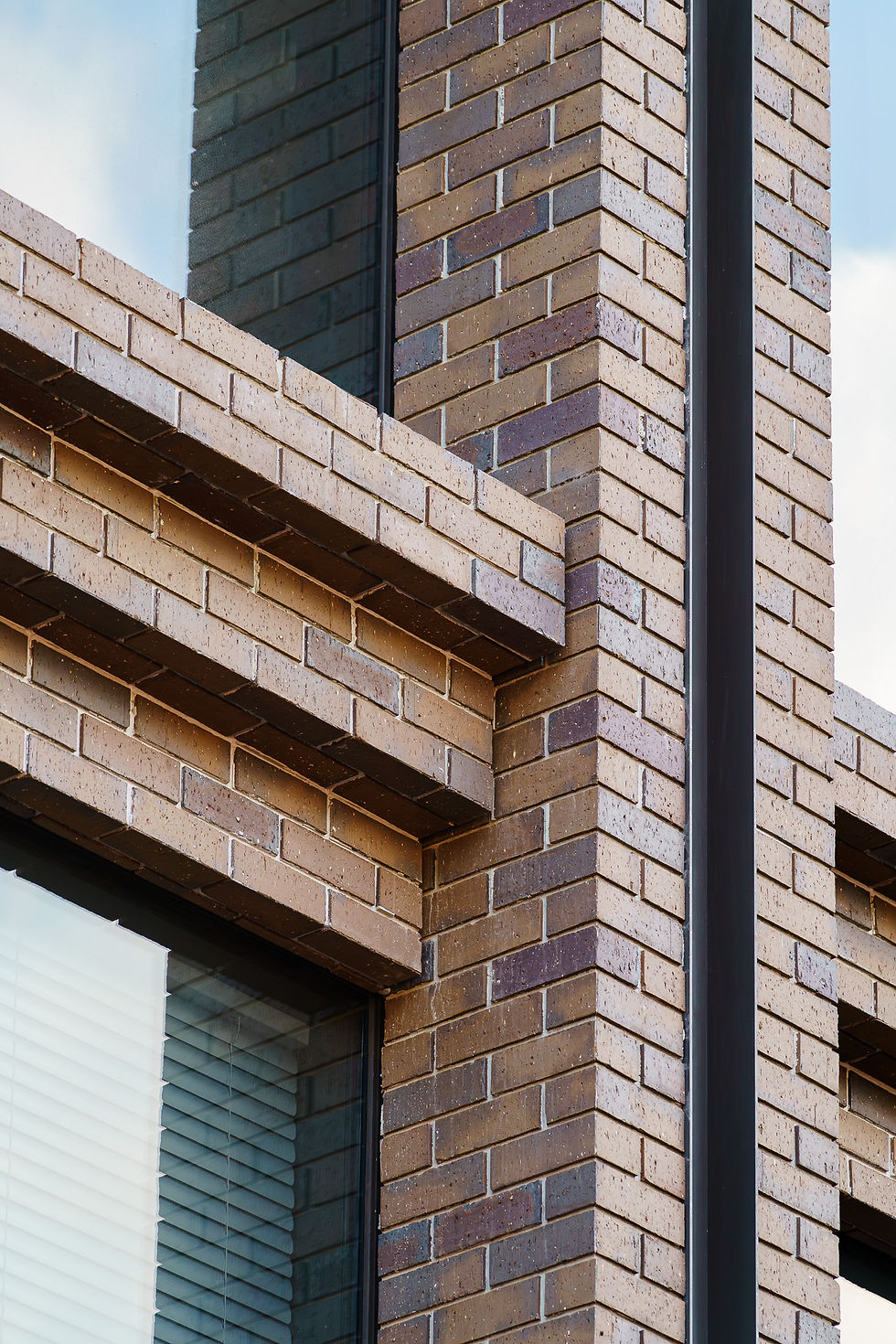
Delivering traditionally laid brickwork across three to four storeys presented challenges, from sourcing skilled trades to meeting construction timelines. So, the conversation shifted toward achieving authenticity using brick slips. “We started exploring how could we use brick slips but making sure it didn't look like it was a veneer. So that's when we started really exploring the different details of how we would create the corners and junctions.”
For Hassell, the façade had to read as solid masonry, and that intention shaped every decision.
Hassell’s golden rule to Maxcon was clear: “Don’t expose the edge of the brick tile. Ever. If we expose that edge, the secret’s out. We worked closely with Maxcon and they really understood the quality outcome we were aspiring to from the start - Maxcon worked collaboratively with us to get the best solution.”

The solution combined brick corbelled columns, stepped façade elements to manage expansion joints, and steel C shaped channels positioned between the brickwork to maintain the appearance of continuous masonry. Working with Euro Precast, multiple prototypes tested various step numbers and depths, carefully aligning dimensions to use whole bricks wherever possible.
Each prototype upheld the golden rule: “We worked through every corner and every detail to make sure that you can never see the edge. Each of the window frames step back and steps into the windows. So, when you look up, it looks like solid bricks.”
Material selection was guided by context and heritage. Hassell collaborated with Robertson’s to refine the colour, referencing nearby warehouses and an 1890s former school building now part of the Kangan Institute. Hassell selected Krause Rustic Tan brick tiles to sit comfortably within this historic setting.
Full scale prototypes at Euro Precast helped verify the colour and see the bricks on mass. “That was so valuable. It’s easy to pick a sample of a single brick or a couple of them next to each other. But with a larger sample sometimes that makes you think differently about it. So, it was great to go and reassure ourselves that the colour was right, the detailing was going to work, and then they could go for it. And we knew that it was all going to work,” Ingrid recalls.
Although new to using Brick Inlay, Ingrid reflects positively on the outcome. “I saw using a brick slip as a little bit of a risk when we started the process, we were really wanting to use a full brick, but I'm super happy with the outcome.”
Beyond visual integrity and construction efficiency, Brick Inlay offered additional advantages. Hassell would readily use the system again, “for speed of construction, it's environmentally better, there's a whole range of reasons why it makes sense to use it.”
For Ingrid, the most rewarding moment was seeing the building take shape. “I always love seeing buildings come together, it doesn’t matter how long you do this, but buildings are always bigger than you imagined they're going to be when you're drawing them. Seeing the brick panels being installed, I got a sense then of how good it was going to look. And that was a great moment.”
Above the brick podium, a glazed upper façade is set back in a striking zig zag pattern, maximising natural light and capturing western views to the city and MCG. Terraces across multiple levels provide generous outdoor space, while landscaping and a pedestrian link enhance connectivity at ground level and movement throughout the site.

Amenity was a key focus for Vicland in attracting quality tenants. In a challenging leasing market with high vacancy rates, the entire building has been leased, which is a significant achievement and testament to the strength of the design and amenity offering. The Commons signed early, its requirements integrated into the design, including a basement wellness centre with plunge pools, ice baths, infrared saunas and yoga spaces, alongside a café and coworking spaces. Additional tenants include Puma and the builder, Maxcon.
33 Cremorne is the product of thoughtful craft, collaboration and rigorous detailing. It’s a high-quality workplace people will enjoy coming to each day, a building grounded in its context and a compelling example of how Brick Inlay’s modern innovation can honour tradition without compromising authenticity.
Ingrid readily agrees, “The result is testament to a very collaborative process with everyone involved. The client had a great vision, the builder was focused on delivering a quality outcome and we had a great high quality product so we were able to detail it in a way where we've elevated that quality to make it feel real.”

Developer: Vicland
Architect: Hassell
Product: Brick Inlay with Krause Rustic Tan brick tiles
Builder: Maxcon
Precaster: Europrecast
Photography: Daniel Bordin Photography


